




 BY Christoph Zumdick IN Industry knowledge
Bulk Label Ordering Guide: Streamlining Your Business Labeling Process
Introduction to Bulk Label Ordering
In today's fast-paced business environment, efficiency is key to staying competitive. Bulk label ordering offers businesses a way to streamline operations, cut costs, and keep branding consistent across all products. Whether you run a small business looking to grow or a large company managing big inventory systems, understanding bulk label ordering can really help your bottom line and make your operations work better.
At Labelprint24, we know that ordering labels can be tricky, especially when you need a lot of them. Our experience since 1961 has taught us that planning your bulk orders saves money and keeps your product line looking consistent. We've helped thousands of businesses make their labeling more efficient while keeping quality high.
Bulk label ordering isn't just buying lots of the same label. It involves planning, choosing materials, thinking about design, and timing production to fit your business needs. This guide will show you everything about ordering labels in bulk, from understanding cost benefits to picking the right materials for your specific needs. By the end, you'll know how to make smart decisions that can make your products look better while saving money.
Benefits of Ordering Labels in Bulk
When it comes to getting labels, quantity really matters. Ordering in bulk offers several big advantages that can help your business operations and save you money both now and later.
Cost Efficiency
One of the best reasons to order labels in bulk is saving money. Setup costs like making plates, adjusting machines, and preparing materials stay about the same no matter how many labels you order. When these fixed costs are spread across more labels, each label costs less. This can save you 30-60% compared to smaller orders. This economy of scale is one of the clearest benefits of bulk ordering.
Also, material costs usually go down with volume as suppliers offer better prices for larger amounts of paper, film, and adhesives. Our premium label production uses these economies of scale to give you the best prices for bulk orders. Many suppliers, including Labelprint24, use tiered pricing that automatically reduces unit costs as order quantities increase.
Consistent Quality and Appearance
Ordering all your labels in one production run ensures they all look the same in color, material, and finish. This consistency is important for maintaining your brand image across all your products. When labels are made in separate batches, even small differences in color or materials can be noticeable and might make customers think less of your brand. With bulk production, all labels are made under the same conditions using the same materials and inks, so they all match perfectly.
Reduced Administrative Overhead
Managing many small orders takes a lot of work – from placing orders and tracking deliveries to processing invoices and keeping inventory records. Combining these into fewer, larger orders saves time and resources spent on procurement tasks, letting your team focus on more important business activities. This streamlined approach can save many administrative hours each year, especially for businesses with many product lines needing different label types. Your accounting department will also have fewer invoices to process and payments to manage.
For businesses with limited storage space, we offer flexible delivery options that allow you to receive your bulk order in scheduled shipments, ensuring you maintain optimal inventory levels without overwhelming your storage facilities. This approach, sometimes called "blanket ordering," combines the cost benefits of bulk purchasing with the practical advantages of just-in-time delivery, giving you the best of both worlds without compromising on quality or efficiency.
Types of Labels Available for Bulk Ordering
Understanding the various types of labels available for bulk ordering is crucial for selecting the right option for your specific application. At Labelprint24, we offer a comprehensive range of label solutions that can be customized to meet your unique requirements, ensuring your products not only look professional but also perform optimally throughout their lifecycle in various environmental conditions.

Adhesive Labels
Adhesive labels are the most versatile and widely used label type across industries. They can be produced on sheets or rolls, depending on your application method and volume requirements. These labels feature a pressure-sensitive adhesive backing that adheres to various surfaces upon application of pressure, making them suitable for nearly any product packaging scenario. The adhesive formulations can be customized based on your specific needs, including factors such as permanence, temperature resistance, and compatibility with different surface materials.
Roll Labels
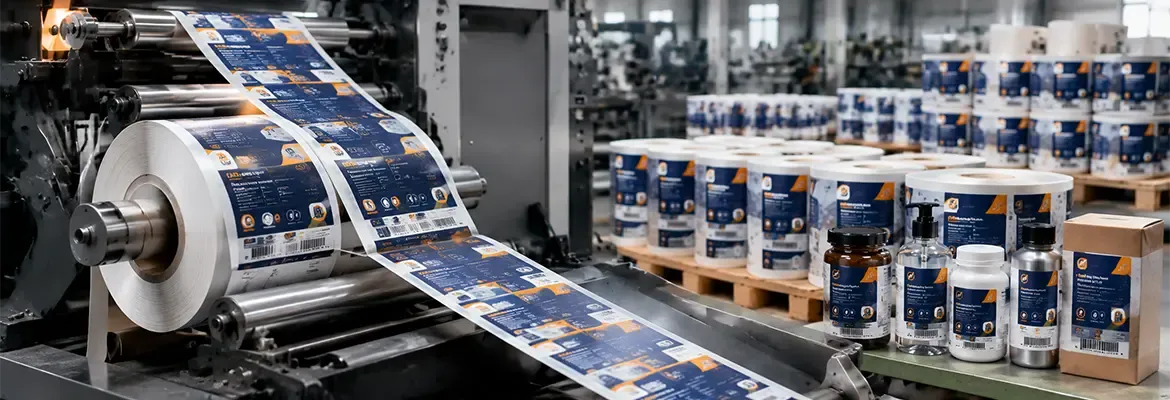
Roll labels are perfect for high-volume applications and automated labeling systems. They work with label dispensers and applicators, making them ideal for production lines where efficiency is important. Our roll label options include various materials and adhesive types to suit different surfaces and environments. The continuous format of roll labels allows for uninterrupted application, greatly increasing productivity compared to sheet labels, especially when handling thousands or millions of units in production.
Key benefits of roll labels for bulk ordering:
- Compatible with automatic labeling equipment for high-speed production environments
- Efficient for high-volume applications with minimal downtime between label applications
- Available in various widths and core sizes to fit different dispensing equipment
- Suitable for thermal transfer printing with our thermal transfer ribbons
- Optimal for continuous production runs with minimal operator intervention
- Can be produced with various unwind directions to accommodate different application systems
Security Labels
Security labels provide tamper-evident features that help protect your products from unauthorized access or counterfeiting. These specialized labels are designed to show visible evidence if they've been removed or tampered with, providing an additional layer of protection for sensitive products, high-value items, or regulated goods. Security features can range from simple void patterns to sophisticated holographic elements, depending on your security requirements and budget considerations.

Material Selection for Bulk Labels
Choosing the right material for your labels is crucial for ensuring they perform as expected in your specific application environment. The material affects not only the label's appearance but also its durability, adhesion properties, and compatibility with different printing methods. Making informed material choices can significantly impact both the performance and cost-effectiveness of your labeling solution, potentially extending product shelf life while enhancing brand perception.
Paper Labels
Paper remains one of the most popular and cost-effective materials for labels. It's available in various finishes, from matte to high-gloss, and can be coated to enhance durability and print quality. Paper labels offer excellent printability, allowing for high-resolution graphics and fine text details that might be challenging to achieve on some synthetic materials.
Advantages of paper labels include being cost-effective for large volume orders (typically 30-50% less expensive than synthetic alternatives), excellent printability for detailed graphics and text, suitable for indoor use and products not exposed to harsh conditions, wide variety of textures and finishes available, and compatibility with virtually all printing technologies.
Film and Synthetic Materials
For applications requiring greater durability or resistance to environmental factors, film and synthetic materials offer superior performance. These materials can withstand exposure to water, chemicals, UV light, and extreme temperatures. Synthetic labels maintain their integrity in conditions that would quickly degrade paper alternatives, making them ideal for products used outdoors, in bathrooms, or in industrial environments where exposure to various elements is expected.
Planning Your Bulk Label Order
Good planning is essential for a successful bulk label order. By carefully thinking about what you need and when you need it, you can make sure your labels arrive on time and meet all your requirements. A well-organized planning process reduces the risk of delays, mistakes, or unexpected costs, while maximizing the efficiency and cost-effectiveness of your label procurement.
Determining Quantity Requirements
Figuring out the right quantity for your bulk order means balancing cost efficiency with practical considerations like storage space and product lifecycle. Ordering too few labels can lead to emergency reorders at higher prices, while ordering too many can tie up money and storage space unnecessarily. A thoughtful analysis of your usage patterns and future needs helps determine the optimal order quantity that maximizes savings while minimizing inventory carrying costs.
Factors to consider when determining order quantity include annual usage rate and seasonal fluctuations based on historical data and sales forecasts, product lifecycle and potential design changes, storage capacity and conditions available at your facility, cash flow and budget constraints, minimum order quantities for custom materials or sizes, potential volume discount thresholds, and risk of obsolescence due to product reformulations, packaging changes, or regulatory updates.
Design Considerations for Bulk Production
When designing labels for bulk production, certain considerations can help optimize quality while minimizing costs. Strategic design decisions made early in the process can significantly impact both production efficiency and final label performance, potentially saving thousands in production costs while enhancing brand presentation across your product line.
- Standardize dimensions: Using standard sizes can reduce material waste and setup time. Even small adjustments to align with standard cutting dies can yield substantial savings across large production runs.
- Color management: Limiting the number of colors or using standard process colors can reduce printing costs. Special or custom-mixed colors typically incur additional charges and setup time.
- Variable data planning: If your labels require variable information (like sequential numbering), plan this aspect early in the design process. Different variable data requirements may influence equipment selection and production methods.
- Bleed and margins: Ensure your design includes appropriate bleed and margins to accommodate slight variations in cutting. This prevents unsightly white edges or critical information being trimmed off during production.
- Material selection influence: Consider how your chosen material affects color reproduction and design elements. Some materials may enhance certain design features while limiting others.
Customization Options for Bulk Labels
One of the advantages of working with a professional label printer like Labelprint24 is the wide range of customization options available, even for bulk orders. These options allow you to create labels that perfectly align with your brand identity and functional requirements, ensuring your products stand out on shelves while communicating essential information effectively. Customization capabilities have expanded dramatically in recent years, making previously premium features more accessible even for large production runs.
Printing Techniques
Different printing techniques offer various benefits in terms of quality, cost, and suitability for different materials and designs. Understanding these options helps you select the most appropriate production method for your specific requirements, balancing visual impact with budget considerations and performance needs.
Digital printing is ideal for short to medium runs and offers several advantages for bulk label orders, particularly when design flexibility or variable data are important considerations. This technology has evolved significantly, now offering quality comparable to traditional methods but with greater flexibility and often shorter setup times. It has no plate costs, making it economical for multiple designs or frequent design changes, excellent for photographic-quality images with smooth gradients and fine details, ability to include variable data without additional production steps, consistent color quality throughout the run, and shorter setup times.
For very large quantities, flexographic printing can be more cost-effective once setup costs are distributed across the entire production run. This traditional printing method remains the industry standard for extremely high-volume label production, offering exceptional consistency and specialized capabilities for certain applications. It has higher production speeds for large volume orders, excellent color consistency for brand-critical colors, ability to use specialty inks including metallics and fluorescents, good performance on a wide range of materials, superior durability for applications requiring extreme weather or chemical resistance, and capability to print opaque white on clear or metallic materials with greater opacity than digital.
Packaging and Storage Solutions for Bulk Labels
Proper packaging and storage of bulk label orders is essential for maintaining their quality until use. Improper storage can lead to adhesive degradation, curling, color fading, or contamination, potentially rendering expensive label inventory unusable. Implementing appropriate handling and storage protocols protects your investment and ensures your labels perform as expected when needed, even months after production.
Optimal Storage Conditions
To maintain label quality during storage, follow these guidelines developed from industry best practices and material science research. Proper storage conditions preserve adhesive performance, prevent material degradation, and ensure consistent application results throughout the life of your label inventory.
- Temperature control: Store labels at room temperature (68-72°F/20-22°C) whenever possible. Avoid temperature extremes or rapid fluctuations that can cause material expansion, contraction, or adhesive oozing.
- Humidity management: Maintain relative humidity between 40-60% to prevent moisture absorption or excessive drying. Both high and low humidity can affect adhesive performance and cause dimensional changes in paper-based materials.
- Light exposure: Protect labels from direct sunlight and UV exposure to prevent fading, yellowing, or material degradation. UV radiation can break down both inks and adhesives over time, even through windows or fluorescent lighting.
- Contamination prevention: Store labels away from dust, chemicals, and other contaminants that could affect adhesion or appearance. Industrial environments require particular attention to airborne particles and chemical vapors.
- Orientation consideration: Store roll labels horizontally rather than on end to prevent uneven pressure that can deform the roll or cause adhesive migration.
Label Application Methods for High-Volume Operations
When dealing with bulk quantities of labels, efficient application methods become increasingly important. The right equipment and processes can significantly improve productivity and consistency, reducing labor costs while ensuring professional results. As production volumes increase, the return on investment for automated application solutions becomes more compelling, often paying for themselves within months through labor savings and reduced waste.
Manual Application Tools
For smaller operations or variable products, manual application tools provide a cost-effective solution that enhances efficiency compared to completely manual processes. These simple devices can increase application speed by 3-5 times while improving placement accuracy and reducing worker fatigue during extended labeling sessions.
Some manual application tools include label dispensers that peel labels from backing for quick hand application, application tools that help ensure straight, bubble-free application through controlled pressure and alignment guides, measurement guides for consistent label placement, ergonomic handle designs that reduce strain during repetitive application tasks, and multi-label dispensers that accommodate different sizes or types for mixed production lines.
Our hand labellers are designed for efficient manual application, with adjustable settings to accommodate different label sizes from 55 to 100 mm. These versatile tools significantly increase application speed while reducing the physical strain associated with repetitive labeling tasks, making them ideal for small to medium production runs or businesses transitioning toward automation.
Label Application Best Practices
Regardless of the application method, these best practices help ensure optimal results across all labeling operations. Following these guidelines minimizes waste from misapplied labels while maximizing adhesion performance and longevity, ensuring your products maintain their professional appearance throughout the distribution chain and consumer use.
- Surface preparation: Ensure surfaces are clean, dry, and free from oils or contaminants that could interfere with adhesive bonding. Even invisible residues can significantly reduce adhesion strength and longevity.
- Temperature considerations: Both the label and the application surface should be at room temperature for optimal adhesion. Cold surfaces can prevent proper initial tack, while excessive heat may cause adhesive to become too aggressive or flow improperly.
- Pressure application: Apply firm pressure across the entire label to activate pressure-sensitive adhesives fully. Insufficient pressure is a common cause of edge lifting and premature label failure.
- Curing time: Allow sufficient time (typically 24-48 hours) for adhesives to reach maximum strength before exposing to challenging conditions. Initial tack provides immediate hold, but full bond strength develops over time.
- Application angle: Apply labels at a slight angle rather than perfectly parallel to prevent air entrapment that causes bubbles or uneven adhesion.
Quality Control in Bulk Label Production
Maintaining consistent quality across thousands or millions of labels requires robust quality control measures throughout the production process. A comprehensive quality assurance programme ensures that every label meets your specifications and performs reliably in its intended application. Quality control becomes even more critical with bulk orders, as any defects are multiplied across the entire production run, potentially resulting in significant waste and customer dissatisfaction.
Pre-Production Quality Checks
Before full production begins, several quality checkpoints help identify potential issues early in the process. These preliminary steps can prevent costly mistakes and ensure the final product meets all requirements. Pre-production validation is particularly important for bulk orders, where corrections during production can be extremely expensive and time-consuming.
Essential pre-production checks include proof approval to verify all design elements, colours, and text are correct before printing begins, material compatibility testing to ensure adhesives work properly with your intended surfaces, print quality assessment on actual production materials rather than just digital proofs, dimensional verification to confirm labels fit existing packaging or equipment, and adhesion testing under expected environmental conditions to validate performance over time.
In-Process Monitoring
During production, continuous monitoring ensures quality remains consistent throughout the entire run. Modern printing equipment includes various sensors and monitoring systems that track colour consistency, registration accuracy, and material properties in real-time. Operators trained in quality control procedures can identify deviations early and make corrections before significant quantities of defective labels are produced.
Key monitoring points during production include colour consistency using spectrophotometers to maintain brand-accurate colours, registration accuracy to ensure multiple colours align properly, cut quality to prevent rough edges or incomplete cutting, adhesive application uniformity to ensure consistent bonding strength, and material tension control to prevent stretching or distortion during processing.
Cost Management and Budgeting for Bulk Orders
Effective cost management for bulk label orders requires understanding all cost components and planning for both immediate expenses and long-term inventory carrying costs. A comprehensive budgeting approach helps maximise the financial benefits of bulk ordering whilst avoiding cash flow issues or excessive inventory investment.
Total Cost of Ownership
When evaluating bulk label orders, consider the total cost of ownership rather than just the initial purchase price. This comprehensive view helps identify the most cost-effective solution over the entire lifecycle of your label inventory, including factors that might not be immediately apparent but significantly impact overall profitability.
Total cost components include initial purchase price including setup fees and tooling costs, freight and logistics expenses for delivery and potential storage, inventory carrying costs including insurance and obsolescence risk, storage facility costs or opportunity costs of warehouse space, handling and internal logistics expenses for inventory management, potential waste from damaged or obsolete inventory, and administrative costs for inventory tracking and management systems.
Total Cost of Ownership
Large bulk orders can impact cash flow significantly, making payment terms an important consideration in supplier selection. Many suppliers offer flexible payment options that help manage cash flow whilst securing bulk pricing advantages. Understanding available payment structures can make bulk ordering more accessible for businesses with seasonal cash flow patterns.
Working with Label Suppliers: Building Successful Partnerships
Establishing a strong relationship with a reliable label supplier is crucial for successful bulk ordering. The right partnership extends beyond simple vendor relationships to become a strategic alliance that supports your business growth and operational efficiency. A trusted supplier becomes an extension of your team, providing expertise and support that enhances your competitive position.
Supplier Selection Criteria
Choosing the right supplier for bulk label orders requires careful evaluation of multiple factors beyond price. The ideal supplier combines competitive pricing with reliable service, technical expertise, and growth capacity to support your long-term needs. Making the right choice prevents costly supplier changes and ensures consistent quality and service over time.
Key supplier evaluation criteria include production capacity and equipment capabilities to handle your volume requirements, quality management systems and certifications that ensure consistent output, technical expertise in materials and applications relevant to your industry, financial stability and business continuity planning to ensure long-term reliability, customer service responsiveness and communication quality throughout the relationship, geographic location and logistics capabilities for efficient delivery, and flexibility to accommodate rush orders or design changes when business needs require quick responses.
Communication and Specifications
Clear communication of requirements and expectations prevents misunderstandings that can lead to costly mistakes or delays. Detailed specifications and regular communication help ensure your bulk orders meet all requirements whilst staying on schedule and within budget. Establishing communication protocols early in the relationship prevents problems and builds trust over time.
Essential communication elements include detailed written specifications covering all technical and quality requirements, regular progress updates during production to identify potential issues early, clear escalation procedures for addressing problems quickly and effectively, documented change procedures that protect both parties when modifications are necessary, and performance metrics that objectively measure supplier performance and identify improvement opportunities.
Future Trends in Bulk Label Ordering
The label industry continues to evolve with new technologies, materials, and production methods that enhance efficiency and expand possibilities for bulk ordering. Understanding these trends helps businesses make informed decisions about label strategies that position them for future success whilst taking advantage of current opportunities.
Digital Integration and Automation
Digital technologies are transforming how labels are ordered, produced, and applied. These advances make bulk ordering more accessible and efficient whilst providing greater flexibility and customisation options. Integration between ordering systems, production equipment, and customer databases streamlines the entire process from initial order to final application.
Emerging digital trends include online ordering platforms that simplify reordering and specification management, automated proofing systems that reduce approval cycles and eliminate errors, real-time production tracking that provides visibility throughout the manufacturing process, integration with customer inventory management systems for automatic reorder triggers, and digital printing advances that make smaller bulk quantities more cost-effective whilst maintaining quality standards.
Smart Labels and Advanced Features
Advanced label technologies are becoming more accessible for bulk production, opening new possibilities for product differentiation and functionality. These technologies can enhance brand value and provide additional customer benefits whilst remaining cost-effective in bulk quantities. As production volumes increase, the per-unit cost of advanced features decreases significantly.
Advanced label technologies gaining traction include QR codes and NFC technology for interactive customer experiences and product authentication, temperature-sensitive materials that provide visual indicators for cold chain monitoring, antimicrobial coatings that provide additional product protection in healthcare and food applications, holographic security features that prevent counterfeiting whilst enhancing visual appeal, and variable data printing that enables mass customisation without sacrificing bulk production efficiency.
Conclusion
Bulk label ordering represents a strategic opportunity for businesses to reduce costs, improve efficiency, and maintain consistent brand presentation across their product lines. The benefits extend far beyond simple cost savings to encompass operational improvements, quality assurance, and competitive advantages that support long-term business success. By understanding the complexities and opportunities involved in bulk ordering, businesses can make informed decisions that optimise both immediate results and future flexibility.
Success in bulk label ordering requires careful planning, appropriate supplier partnerships, and attention to quality throughout the entire process. From initial quantity determination and material selection to storage management and application procedures, each decision impacts the overall value and effectiveness of your labeling programme. The investment in proper planning and execution pays dividends through reduced costs, improved operational efficiency, and enhanced product presentation that supports brand value and customer satisfaction.
As the label industry continues to evolve with new technologies and materials, bulk ordering strategies must also adapt to take advantage of emerging opportunities whilst maintaining cost-effectiveness and quality standards. Businesses that embrace best practices in bulk label ordering position themselves to benefit from economies of scale whilst maintaining the flexibility to respond to changing market demands and customer expectations.
At Labelprint24, our decades of experience in bulk label production have taught us that the most successful projects begin with thorough planning and clear communication between all stakeholders. Whether you're ordering thousands or millions of labels, our team provides the expertise and support necessary to ensure your bulk label orders deliver exceptional value and performance. Contact us today to discuss how our bulk label solutions can support your business objectives whilst delivering the quality and reliability your products deserve.