Custom-made ManufacturingCustom-made Manufacturing
Express ProductionExpress Production
Premium Quality since 1961Premium Quality since 1961
Professional Expert AdviceProfessional Expert Advice

GHS labels

ghs-etiketten.jpg

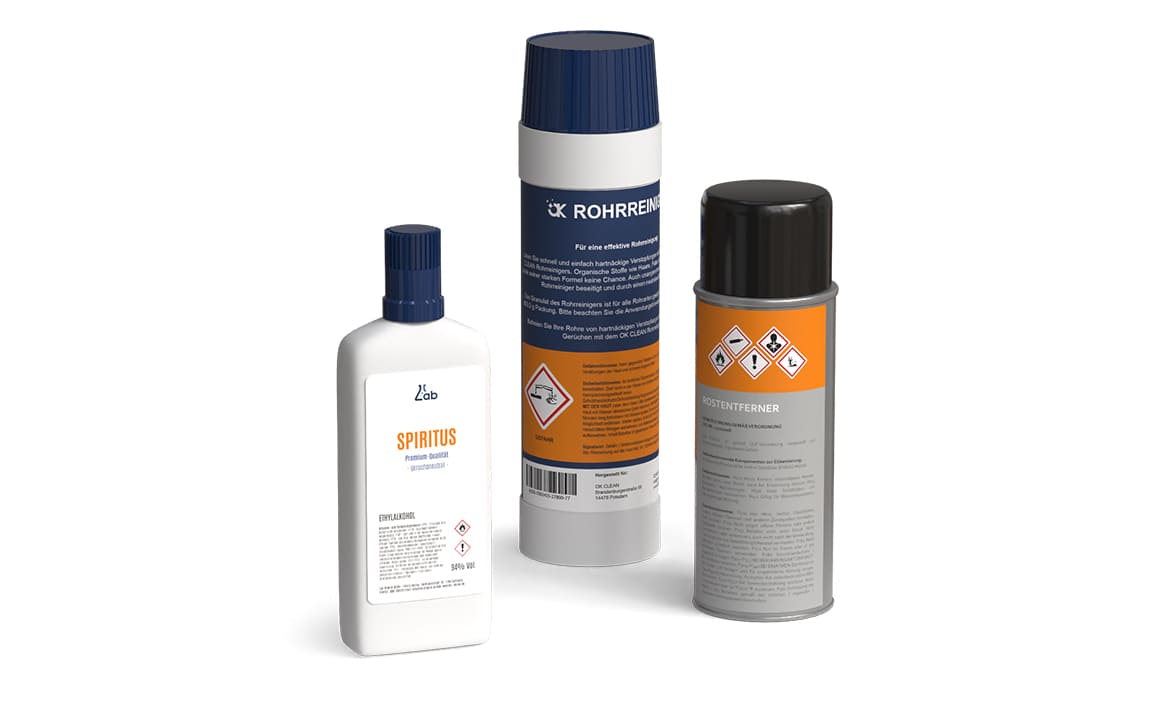
GHS labels are used to label chemicals in accordance with the international system. They clearly indicate risks and promote safe handling. Take advantage of our wide range of materials and standardised label formats, or choose your own dimensions using the product configurator.

  • Have GHS-compliant pictograms printed
  • For chemicals & industry

Select GHS labels and calculate online!

  • Production
    From 2 working days
  • Size
    Custom size
  • Options
    Film finishing / Varnish / Laminate
  • Online Designer
    Custom Design
  • Printing Technology
    Digital / Flexo

Select kind of product

Best price calculator

Spot colours are simulated in Euroscale
Price
£34.41 Net price incl. shipping costs
Vorkasse
PayPal
Visa
Mastercard
American Express

Made in Germany

48h Expressproduktion

Bestpreis Konfiguration

Recycelbare Materialien

Hazardous substance labelling for greater safety in the workplace and for end users

GHS/CLP labels are compliance-driven: the layout must clearly accommodate the required pictograms and labelling information. Under CLP, each pictogram must occupy at least 1/15 of the minimum label area and be at least 1 cm² in size. In addition, a UFI may be required for hazardous mixtures. The UFI must appear on the label and be marked with “UFI:”.

Choosing the right material made easy:

Material: fluorescent paper (yellow/red/green)

  • Ideal for indoor warning stickers when notices need to stand out immediately (e.g. Caution, Warning, Do not stack, Fragile, Restricted area). Fluorescent colours increase visibility from a distance and are particularly practical for warehouse labelling, production areas or temporary warning notices.

    Implementation tip: use a short message, a clear pictogram and sufficiently large text for quick readability.

Material: white PP film, permanent (💰)

  • The cost-effective film-based option for warning and information stickers when reliable adhesion is required in warehouses, production areas or industrial environments. As a film material, PP is typically more resistant than paper and is suitable for warning labels that are regularly touched, wiped down or applied to packaging and containers throughout the process. 
    It is particularly useful for standard warning labels such as Caution – hot, Do not open, Internal labelling, inspection labels or safety and process information.

Material: white PVC film, permanent

  • For warning stickers that are exposed to heavy use or need to remain in place for a longer period of time (e.g. machine labelling, outdoor-adjacent areas, doors/containers, workshop environments). PVC is the robust option in our range: it is suitable when warning labels are subject to mechanical stress and the surface is not perfectly flat.
    PVC is also a good choice when warning stickers are exposed to sunlight and more demanding weather conditions. Another advantage: it is also suitable for uneven surfaces.

Material: glossy PE film, extra-strong adhesive / high initial tack

  • For warning stickers applied to difficult substrates where standard adhesives quickly reach their limits: low-energy plastics (e.g. PE/PP surfaces), rough or slightly textured surfaces, certain coated materials or challenging surfaces in everyday logistics. High tack is the right choice when the warning sticker needs to adhere securely straight away and must not start to peel off after just a few hours.
    Typical use cases include warning labels on plastic crates, transport boxes, canisters, PE/PP packaging, difficult containers or rough industrial surfaces.


FAQ

Does the UFI have to appear on the label?

→ yes, if a UFI is required; the SDS alone is not sufficient

Are there minimum size requirements?

→ yes, for labels and pictograms according to CLP tables and rules

Paper or film?

→ choose according to the environment and level of stress.