




 BY Elisa Savietto IN Industry knowledge
Hazardous substance labelling - what does the label say?
Standardised hazardous substance labels can be found on all printed packaging containing hazardous substances or hazardous mixtures. To protect the people who work with them and, of course, the environment, the containers or cartons must be labelled if the substances or mixtures are placed on the market or activities are carried out with them.
But what all falls under the term hazardous substances? And how are they correctly represented on labels and other carriers? In this article you will find all the relevant information on this extensive topic.
Definition: What are hazardous substances?
There are many properties of hazardous substances that can become a problem in general or if the substances or their packaging are not handled properly. They are defined here according to different chemical and physical groups:
- Pure substances: These are either the individual chemical elements (e.g. hydrogen, H) or a chemical compound of at least two elements (e.g. water from hydrogen and oxygen, H2O).
- Mixtures: They consist of at least two pure substances - which means that there are many possibilities between smoke and emulsions for the existence of such substances.
- Products: In contrast to substances and mixtures, the focus here is on the technical properties, not the chemical properties. The boundary often only runs along a legal definition. For example, ballpoint pens are considered mixtures by EU legislators, whereas batteries are categorised as articles.
Hazardous substances are therefore pure substances or mixtures or products with at least one dangerous characteristic. They can cause damage to living organisms or dead material, can burn, explode or damage the environment. It is irrelevant whether these properties already exist in their basic state or only occur during manufacture or (improper) use.
Note: For ease of understanding, we use the terms "hazardous substances" and "substances" in general in the following and only refer to (pure) substances, mixtures or articles where this is necessary for factual accuracy.
What types of hazardous substances are there?
The very definition of a hazardous substance shows that many properties come together under this heading. The most important definition of hazardous substances in Germany can be found in the Hazardous Substances Ordinance (GefStoffV). This ordinance sets out all the requirements for hazardous substance labelling and legally compliant packaging.
Paragraph 3 of the Hazardous Substances Ordinance basically distinguishes between four different types of hazards, which in turn include different properties of the respective hazardous substances. The law lists a total of 28 different properties:
Physical hazards:
- Aerosol: Finest, airborne solid or liquid particles.
- Flammable: Flammable under defined ambient conditions.
- Explosive: Builds up temperature and pressure particularly quickly.
- Pressurised gases: danger of bursting.
- Gas evolving: Flammable gases are formed on contact with water.
- Corrosive to metals: Changing the properties of the metal.
- Organic peroxides: Various derivatives of hydrogen peroxide.
- Oxidising: All reactions that resemble a reaction with oxygen.
- Pyrophoric: Self-igniting under defined ambient conditions.
- Self-heating capability: Self-generating heat above 120°C under defined ambient conditions.
- Self-decomposing: Unstable and exothermically self-decomposing.
Health hazards (generally for living organisms):
- Acutely toxic: Harmful to various tissue types and organs or only specific (target) organs (under defined conditions).
- Corrosive or irritant: Damaging or causing inflammation of skin and mucous membranes.
- Eye damage/irritation: Causes eye damage or inflammation.
- Skin or respiratory sensitising: Causes allergies and comparable body reactions.
- Germ cell mutagens: Causes permanent changes in the cell material.
- Reproductive toxicity: adversely affects fertility, sexual function and/or embryonic development.
- Carcinogen: Causes cancer or increases the likelihood of cancer.
- Aspiration hazard: May enter the oral or nasal cavity or cause vomiting into the trachea or lungs, disrupting breathing and/or damaging the respiratory organs.
Environmental hazards:
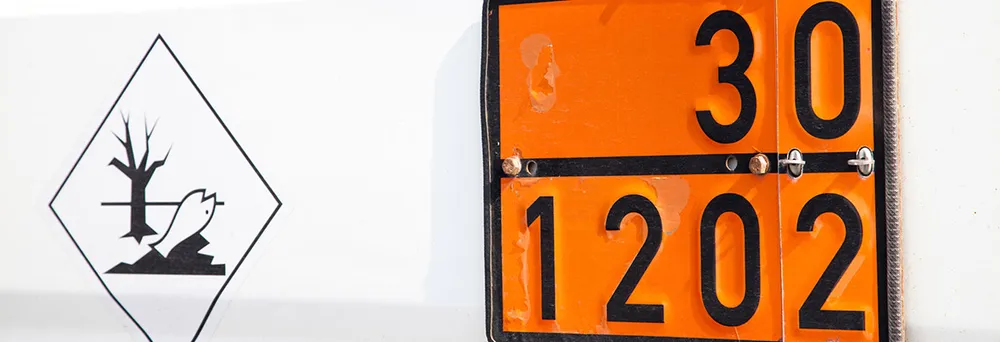
- Hazardous to the aquatic environment: Harmful to the aquatic biosphere (animals, plants, the water ecosystem in general).
Other dangers:
- Ozone depleting
The GefStoffV also defines the following as hazardous substances:
- All substances specifically listed in § 3,
- Substances that are explosive under any circumstances,
- Substances whose manufacture or use generates hazardous substances,
- Substances that are not hazardous substances per se, but which are relevant to occupational safety due to their properties, and
- Substances for which there is a defined occupational exposure limit.

Product Advisor for Labels
Whether it’s a simple roll label or a multi-layered specialty label – I’m your go-to person for questions concerning materials, adhesion, and finishing of labels for the pharmaceutical, cosmetic, food, chemical, and almost any other industry.
"Paper or film? We've got the perfect label!"
I will be happy to help you personally.
Are there differences between hazardous substances and dangerous goods?
Anyone who deals with the topic of labelling hazardous substances will almost automatically come across the term hazardous goods. Even if the terms sound similar, they differ significantly from each other:
- Hazardous substances: Hazards arise from their manufacture, storage or use.
- Dangerous goods: These are only substances that pose a danger during transport of any kind.
This means that hazardous substances are not automatically hazardous goods, but can be - for example, if a lorry is transporting thousands of bottles of lighter fluid. There are also dangerous goods that do not count as hazardous substances. This is the case, for example, when lithium-ion batteries are transported by air.
What is the GHS?
Hazardous substances are logically equally dangerous everywhere in the world - even if the definitions and limit values may differ from country to country. Hazardous substances are also produced, used and transported across borders all over the world.
Most countries developed their own labelling systems and hazardous substance labels decades ago. These have increasingly become an obstacle to global trade.
For this reason, the UN developed a comprehensive set of model regulations, including symbols, starting in 1992. This system was called
Globally Harmonized System of Classification,
Labelling and Packaging of Chemicals
known as GHS for short. A globally standardised model that standardises labels, data sheets and symbols for labelling hazardous substances worldwide.
The basic idea was to make the respective hazards understandable regardless of language, education and even reading ability. In the EU, the system was introduced as the CLP Regulation (Classification, Labelling and Packaging) with minor changes from 2008. The current German Hazardous Substances Ordinance can also be traced back to this GHS Regulation.
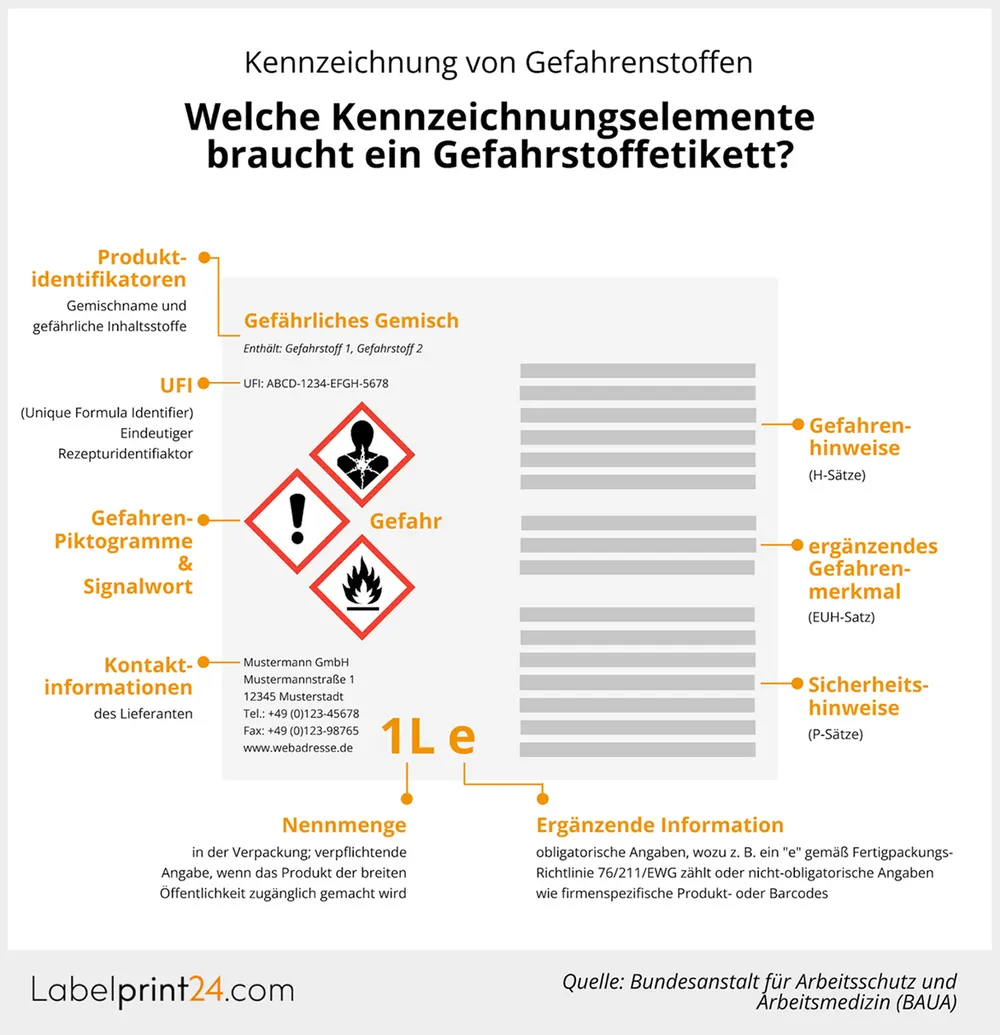
All hazardous substances are labelled according to this scheme on labels and similar documents:
- A red diamond (square standing on its tip) with a white inner part. It contains one of nine defined symbols.
- A code that begins with GHS and contains numbers from 01 to 09.
- A code beginning with H and then containing 2, 3 or 4 ("H statement") for the exact type of hazard. In addition, two further digits that specifically indicate the content.
- A fixed signalling word in the national language.
- More specific information in the national language on the exact content, its effect, the quantity, countermeasures and the distributor (including address details).
Together, this results in the GHS pictogram. A similar system is also used for hazardous goods: the different classes of hazardous goods are based on the same nine symbols, among other things, but are able to distinguish hazardous goods more clearly at a glance thanks to different colours.
What do the GHS pictograms look like?
The Hazardous Substances Ordinance lists a total of 28 different hazardous substances - each of the nine GHS pictograms stands for several hazard classes.
| Cell | Cell | Cell |
| Acutely toxic substances / mixtures Code 4 Skin irritating substances / mixtures Code 2 Skin sensitising substances / mixtures. Target organ toxic substances / mixtures Code SE3 (single exposure). Ozone layer depleting substances / mixtures | ||
| Attention or no signal word depending on the exact type | Cell | Cell |
| Symbol | Description | Hazard class | GHS-Code | Signal word |
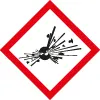 | Exploding bomb | Explosive Stoffe / Gemische und Erzeugnisse mit Explosivstoff. Teilweise selbstzersetzliche Stoffe / Gemische. Teilweise organische Peroxide. | GHS01 | Danger |
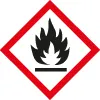 | Flame over line | Flammable gases / liquids / aerosols / solids. Pyrophoric liquids / solids. Partially self-reactive substances / mixtures. Self-heating substances / mixtures. Flammable gases evolving on contact with water. Partially organic peroxides. | GHS02 | Depending on the exact type of danger or caution |
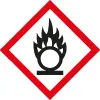 | Flame over circle | Oxidising gases / liquids / solids | GHS03 | Danger |
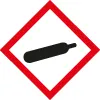 | Glass bottle | Compressed / liquefied / frozen liquefied / dissolved gases | GHS04 | Attention |
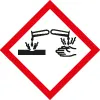 | Two test tubes, including damaged surface and hand -> etching effect | Substances / mixtures corrosive to metal. Skin / eye irritating / damaging substances / mixtures | GHS05 | Depending on the exact type of danger or caution |
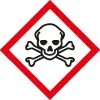 | Skull with bones crossed underneath | Acutely toxic substances / mixtures Codes 1 to 3 | GHS06 | Danger |
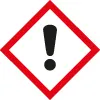 | Exclamation mark | Acutely toxic substances / mixtures Code 4 Skin irritating substances / mixtures Code 2 Skin sensitising substances / mixtures. Target organ toxic substances / mixtures Code SE3 (single exposure). Ozone layer depleting substances / mixtures | GHS07 | Attention |
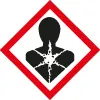 | Human torso | Respiratory sensitising substances / mixtures. Germ cell mutagens / Reproductive toxicants / Carcinogens Substances / mixtures. Target organ toxic substances / mixtures Codes SE1, SE2 (single exposure). Target organ toxic substances / mixtures Codes RE1, RE2 (repeated exposure). Aspiration hazardous substances / mixtures | GHS08 | Depending on the exact type of danger or caution |
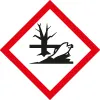 | Dead tree and dead fish | Acutely / chronically hazardous substances / mixtures / products | GHS09 | Attention or no signal word depending on the exact type |
It depends on the specific hazardous substance whether only one or several of these symbols appear on its labelling.
FAQ
- Can I download the pictograms for labelling hazardous substances everywhere?
Theoretically yes, as they are generally available. However, to avoid any problems, it is advisable to download them from official sources. Among others, the German Social Accident Insurance Institution for the raw materials and chemical industry provides high-resolution symbols -> https://www.bgrci.de/fachwissen-portal/themenspektrum/gefahrstoffe/ghs/inhalt-von-ghs/kennzeichnung - Do I have to have the pictograms printed in colour on the label or is black and white permitted?
No, the pictograms may only be printed with a red border. In addition, no further changes are permitted. - Do I have to use GHS-compliant hazardous substance labelling or are earlier labels still permitted?
Since the mid-2010s, only GHS-compliant labels have been permitted - both in Germany and the EU. - Where do I have to affix GHS-compliant labels?
Wherever it is specified in the Hazardous Substances Ordinance and the Technical Rules for Hazardous Substances (TRGS) 201. This applies to in-house systems as well as packaging that goes to the end consumer.